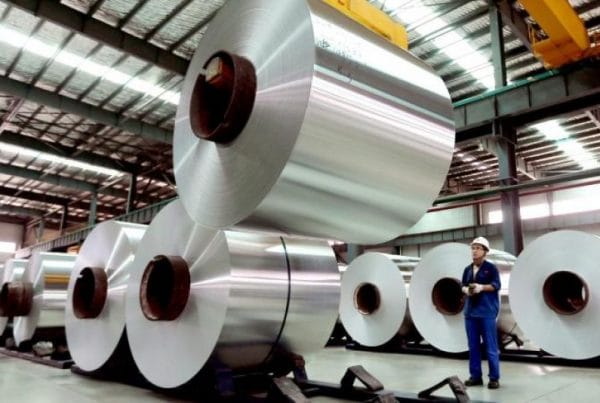

With increasing use in the energy and automotive sectors, aluminum sales could reach $238 billion by 2028, according to estimates, up from $142 billion in 2021.In an interview, the founder of Harbor Aluminium says that excess inventory is a growing risk that could force producers to lower prices.
Demand for aluminum skyrocketed this year, and prices hit an all-time high (ATH) in March, as the post-pandemic consumption boom drove strong demand for electric vehicles (EVs), household appliances, and renewable energy equipment, all of which use the silver-gray metal as a component. Play the video
JORGE VÁZQUEZ, FOUNDER OF HARBOR ALUMINIUM, DISCUSSES THE ALUMINUM MARKET WITH JIN CHANG, GLOBAL HEAD OF METALS AT CME GROUP.
Amid such volatility in demand and prices, futures traders are rushing to manage price risk. Demand is so dynamic that CME Group saw the trading volume of physical aluminum triple from the first to the third quarter of 2022, with a record 3,700 contracts changing hands daily.
To further grow its business, CME partnered with the financial services firm Marex in October to expand its clients' access to its suite of base metals.
"Clients have come to us asking for a viable alternative for managing risk in the aluminum sector and the base metals industry in general," said Jin Chang, managing director and global head of metals at CME, during a recent panel at the Open Markets Exchange of Ideas."Volatility is here to stay, and we need the right risk management tools to handle it, as well as transparency around price discovery."
Andy Massey, vice president of metals, procurement, and transportation at U.S.-based Bonnell Aluminium, added that demand for electric vehicles remains high, driving current and future adoption of the lightweight metal. "The aluminum market is booming right now," he noted. "We're using more and more aluminum in cars. We used to get excited about 300 pounds per vehicle, but with some of the EV models, we’re seeing 500 to 800 pounds. It’s really a huge leap.”
A $240 billion market
Aluminum purchases—which are also used to manufacture airplanes and renewable energy equipment such as wind towers and solar panels—remain strong in the United States, although they have slowed in Europe and China, Massey added. Europe has been affected by the war between Russia and Ukraine and rising energy prices, while China continues to be negatively impacted by its strict “zero-COVID” policy, as well as by droughts affecting key production centers.
Overall, however, growth is expected to remain strong, with base metal sales forecast at $238 billion by 2028, up from $142 billion last year, according to a report by SkyQuest Technology Consultancy.
"In the long term, the outlook for aluminum metals is good," Chang added. "This is because it is a key component in the clean energy transition, and aluminum and copper are also very important components in electric vehicles."
The automotive industry is the world's largest consumer of aluminum and produces nearly 67 million vehicles per year, according to SkyQuest. China is the largest producer, accounting for 60% of production, followed by Russia, then Europe and the U.S. Global aluminum production totaled 68.9 metric tons through October 2022,
'Loan of the Future'
As the world faces a potential recession (the International Monetary Fund recently lowered its global growth forecast to 2.7% from 3.8% in January), fears of a global supply glut are mounting.
Jorge Vázquez, founder of the leading consulting firm Harbor Aluminium, sees excess inventory as a growing risk. Demand is already beginning to decline, so the pandemic-induced oversupply may soon struggle to find a market, squeezing margins and forcing producers to lower prices.
“During the pandemic, consumers bought new homes, boats, motorcycles, and even washing machines—all of which are aluminum-intensive products,” Vázquez told Chang in a recent interview. “In a 12-month period, we bought more than we would have bought over a three-year span. In other words, we borrowed demand from the future.”
That, Vázquez argued, will undermine consumption and send prices spiraling in the coming months. With higher interest rates and a lack of economic stimulus, “things will get a little more complicated,” he added.
Impact of the sanctions?
When asked how a new round of U.S. sanctions against Russia might affect the sector, Vázquez said that a repeat of the 2018 sanctions would cause prices to rise.
“If, for any reason, the U.S. imposes sanctions on Russian aluminum—if they repeat what they did in 2018, when U.S. and non-U.S. individuals were prohibited from purchasing from or providing services to companies that source Russian aluminum—prices and premiums would skyrocket,” he explained. “However, if the U.S. simply bans Russian aluminum in the U.S. or raises tariffs—since we import very little from Russia—the impact on prices and premiums will be negligible.”
In 2018, when Washington imposed tariffs on the Russian aluminum company Rusal, the move sent prices soaring.
“Initially (shortly after the invasion of Russia), the fear of sanctions was real, but the market has moved past that,” says Guy Wolf, global head of market analysis at Marex. “The experience in 2018, when the U.S. imposed sanctions on Russian aluminum, was that the only ones who suffered were domestic consumers. U.S. automakers suddenly found themselves at a huge cost disadvantage.”
What to see?
Meanwhile, the panelists discussed some of the key events to watch for in 2023.
“If I had to pick one thing, I’d look at base metal production, including aluminum, and monitor demand to see where it’s headed…,” Massey said. “I wonder if the economy will be as bad as expected next year and if there will be a surplus.”
For his part, Wolf said he would monitor prices. “I would look at inflation expectations,” he said. “Central banks are a bit mistaken in thinking that the recent inflation problem is due to demand being too strong. Inflation is high because of the one-time energy shock caused by the situation in Ukraine.”