
This is due to doubts about future supply, given that Russia is the world's leading producer. Another factor is the risk of a drop in energy supply in Europe, which could affect production plants in Europe.
It is well known that in politics and economics, as in life itself, any movement in one direction or another generates a reaction in other variables, and that is precisely what happened on Thursday in the global metals market.
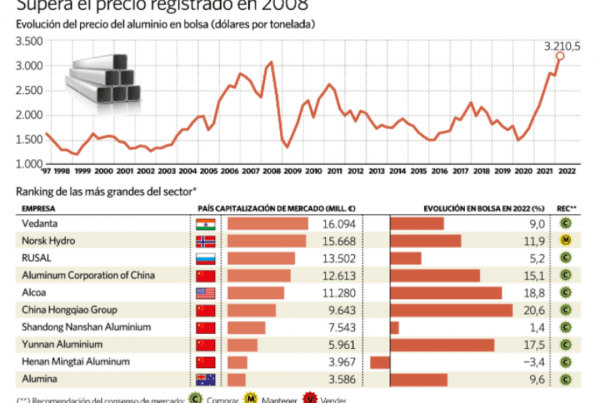
Aluminumprices on theLondon Metal Exchange (LME)reached historic highs.This occurred after news outlets around the world reported on everymovement of Russian and Ukrainian troops throughout the day, in a conflict that has just entered the military phase and still does not clearly show how deep the clash between the two countries will be.

Aluminum prices rose to a record high on Thursday, reflecting in the value of the boards that Moscow's invasion of Ukraine indicates thereal possibility of new sanctions being imposed, according to Reuters.
These sanctions "could cut off supplies from their main producer, Russia, and disrupt the energy supply needed to produce the metal," the agency reported.
There are also fears ofsanctions affecting the operations of Rusal,the leading Russian company in the sector and one of the largest in the world, which has already been subject to restrictive measures by the West in the past.

On Thursday, Russia launched afull-scale invasion of Ukraine by land, air, and sea,the largest attack by one state against another in Europe since World War II, which ended up confirming the West's worst fears regarding this conflict.
WHAT COULD HAPPEN WITH THE INCREASE IN GAS PRICES
But for the commodities market, it is also key that Russia is one of the main producers of gas used to generate electricity, which is a key input for aluminum production. The lack of aluminum will affect the supply ofcans for food and beverages,construction materials, and evenvehicles andelectronic products.
Russia produces about6% of the world's aluminum andaccountsfor approximately10% of the global supply of nickel, a metal that also saw prices "soar" to their highest levels in more than a decade. On Thursday, nickel rose 1.7% to$24,800 per ton,after hitting $25,705 per ton, the highest since May 2011.

Since tensions began in Eastern Europe,gas prices have skyrocketed andoil crossed thepsychological barrier of $100 per barrel on Thursday, with projections pointing to $130 per barrel by June.
This situation, combined with rising gas prices in Europe, triggered"cuts in aluminum production,leaving consumers struggling to obtain the metal," according to Reuters.
This situation, combined with rising gas prices in Europe, triggered "cuts in aluminum production,leaving consumers struggling to obtain the metal," according to Reuters.
WHAT ABOUT THE PRICES OF OTHER METALS?
The market shows that three-month aluminum on the London Metal Exchange "reached arecord high of $3,480 per ton on Thursday, and at 17:15 GMT it was up 3.3% at $3,402.
"Russia is one of the largest producers of aluminum, and much of its material goes to Europe. Broader sanctions could further restrict supply," said Amelia Fu, head of commodity markets strategy at Bank of China International.
The lower supply of aluminum translates into physical premiums paid by consumers above the London Metal Exchange price, a premium that is at historic highs in Europe at $464 per ton and $795 per ton in the United States.
Zinc also rose, recovering 2%to US$3,641, andleadrose 1.7% to US$2,351, whilecopperremained stable at US$9,871 per ton.
News from Cronista.com