
An article focused on the aluminum industry, based on the piece “Bahrain, the most fragile kingdom
in the Persian Gulf in the face of Shiite fury,” by Eduardo Álvarez in EL MUNDO.
“It produces 10 percent of the world’s aluminum”
Taken as a central idea, this phrase sums up the Gulf’s industrial weight in the aluminum sector and helps explain
why Bahrain’s fragility transcends the political realm and also becomes a market factor.
The recent situation in Bahrain has once again brought to light a reality that, for those of us who work in the aluminum industry, cannot be viewed solely through a geopolitical lens. Eduardo Álvarez’s article in EL MUNDO, which focuses on the kingdom’s political and social fragility, also serves as a reminder of something essential from an industrial perspective: events in the Persian Gulf have the direct potential to disrupt the balance of the global aluminum market.
There is a phrase that sums up that scale well: “It produces 10 percent of the world’s aluminum.” Strictly speaking, that percentage best describes the Gulf as a whole rather than Bahrain alone. Reuters estimates that the Middle East accounts for about 8%–9% of global aluminum supply, while official economic promotion sources in Bahrain attribute more than 2% of world production to the country—an extraordinary figure for an economy of its size. In other words: Bahrain may not account for that 10% on its own, but it is part of one of the most critical production hubs on the planet for this metal.
Bahrain, an industrial powerhouse in a fragile environment
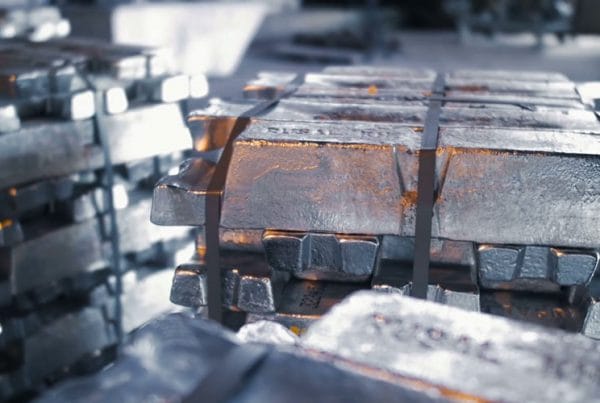
And this is not just an abstract significance. Aluminum Bahrain, known as Alba, closed out 2025 with a record production of 1,623,139 metric tons and continues to rank as the world’s largest single-site aluminum smelter. That fact alone explains why Bahrain occupies such a prominent position on the global primary aluminum map. Furthermore, aluminum’s role in the Bahraini economy is far from marginal: crude aluminum alloys were once again the country’s leading non-oil export in the fourth quarter of 2025.
From our industry’s perspective, the real problem arises when that production burden intersects with an unstable regional environment. The Strait of Hormuz is a critical artery for energy flows and also for aluminum. Reuters estimates that more than 5 million metric tons of aluminum per year are shipped via this route from Gulf producers, and that the region exports approximately 75% of its production. When tensions arise along this route, the impact is not confined to the source: it reaches Europe, the United States, and the entire processing chain.
Hormuz: Regional Tensions Affecting Prices, Supply, and Delivery Times
That is exactly what we began to see in March. Alba invoked force majeure in its contracts due to the inability to ship metal as usual, and a few days later began a controlled shutdown equivalent to 19% of its capacity. At the same time, the market reacted strongly: aluminum prices on the LME reached levels not seen since 2022, and physical premiums in Europe and the United States came under even greater pressure. What is significant here is not just the price movement, but what it reveals: a market that was already sensitive has demonstrated just how dependent it is on the logistical and political stability of a very specific region.
Why This Idea Matters to the Aluminum Industry
For a company like Alueuropa, these kinds of events reinforce an idea that we in the industry know well: aluminum does not depend solely on industrial demand, energy, or production capacity. It also depends on geography, the security of shipping routes, and the stability of major supply hubs. When a region that accounts for nearly 10% of the world’s aluminum enters a spiral of uncertainty, the impact quickly spreads to costs, lead times, availability, and planning.
That is why it is important to view the situation in Bahrain from two perspectives simultaneously. The first is political: a small kingdom, strategically located and with well-known internal tensions. The second is industrial: a key player in a region that is crucial to the international supply of aluminum. It would be a mistake to separate these two perspectives. Today more than ever, the geopolitics of the Gulf are also the geopolitics of aluminum.
At Alueuropa, we will continue to monitor these developments closely, because understanding aluminum requires looking beyond the metal itself: it also requires understanding the external factors that shape its market. And on that map, Bahrain and the Persian Gulf occupy a much more important place than their size might suggest.
Source: Eduardo Álvarez, EL MUNDO, “Bahrain, the most fragile kingdom in the Persian Gulf in the face of the Shiite fury.”