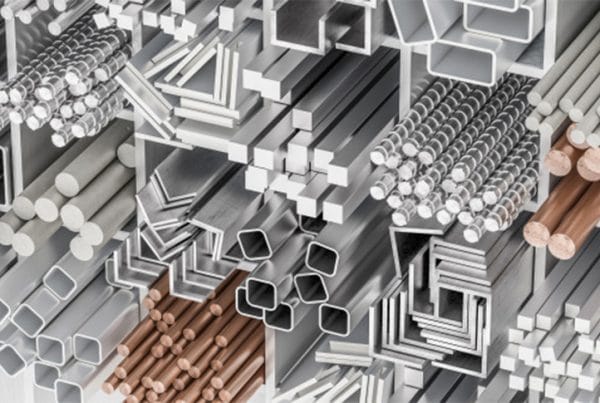

Malleable, resistant to extreme temperatures, electrically conductive, waterproof... these are just some of the properties that have made it absolutely indispensable.
In 1865, French authorJules Verne publishedFrom the Earth to the Moon, in which the spacecraft carrying the "first astronauts" was made of aluminum, requiring approximately 9,000 kilograms. This figure would be anecdotal were it not for the fact that it almost coincides with the amount needed to manufacture theApollo 8 capsule more than a century later.
When the French writer conceived his spaceship with that unique feature, it had been barely four decades since Danish physicistChristian Oersted(1777-1851) had isolated aluminum for the first time.
Bauxite, the mother of aluminum
A late discovery despite the fact that this element is, after oxygen and silicon, the most common in the Earth's crust, and holds the title of being the most abundant metal in nature, ahead of iron and manganese.javascript:falseADVERTISEMENT
The reason why it took so long to be isolated is because it is not found in its free state; it must be extracted from a reddish mineral called bauxite. This mineral owes its name to the fact that it was first discovered in the village of Les Baux, in Provence, byPierre Berthier.
In 1866,Paul Heorult andCharles Hall developeda process whereby aluminum oxide is melted in cryolite and subjected to electric currents. This process allows aluminum to be created from bauxite. It is estimated that four tons of this mineral are needed to obtain two tons of alumina, from which one ton of aluminum is ultimately extracted.
Natural deodorant
A few years ago, in tomb A6 of a 1st-century AD necropolis located near the ancient cityof Augusta Emerita, ateam of archaeologists discovered the remains of makeup in a scallop shell that was used as a case or powder compact.
In it, they discovered remains of a product that had remained intact throughout this time. It is thought to have contained a cosmetic obtained from a plant called madder (Rubia tinctorum), which was obtained through the use of alum as a fixative.
Alum, or double sulfate of aluminum and potassium, is a translucent white mineral that was used as a cosmetic by the Sumerians, Egyptians, Greeks, and Romans. After being moistened and applied to the skin, it leaves a layer of minerals that have a bactericidal effect and eliminate underarm odor.
Alum stone was also used for centuries as aftershave, as this element promotes skin healing.
An environmentally friendly material
We currently use aluminum in many areas of our lives, from high-speed trains to windows, transmissions, telecommunications, automobiles, and beverage cans. This is thanks to a whole range of properties, including malleability, conductivity, and lightness. It is also perfect for creating barriers against gases, moisture, light, and oxygen, a feature that makes it ideal for protecting pharmaceutical products and preventing quality loss. Its excellent conductivity makes it indispensable for the construction of cables, as it allows the transmission of electricity at over 700,000 volts.
Furthermore, and this is also very important, aluminum can be 100% recycled, which makes it highly environmentally friendly and a guarantee of sustainability. It is estimated that recycling aluminum consumes only 5% of the energy needed to extract it.
Article from ABC.es